“If you are pursuing grad school, this program makes the unreachable goal feel reachable.”
When we launched our first SEACrowd Apprentice Program in 2024–25, it started as a simple question: Could we help early-career talent across Southeast Asia go from “I’m curious about AI research” to actually publishing real work—remotely and part-time? That first cohort answered with a clear yes, producing two workshop papers and a new regional dialogue dataset (read last year’s retrospective here).
Batch 2026 was a bigger test: could we scale the program to more teams, run on a tighter schedule, and make the experience even stronger?
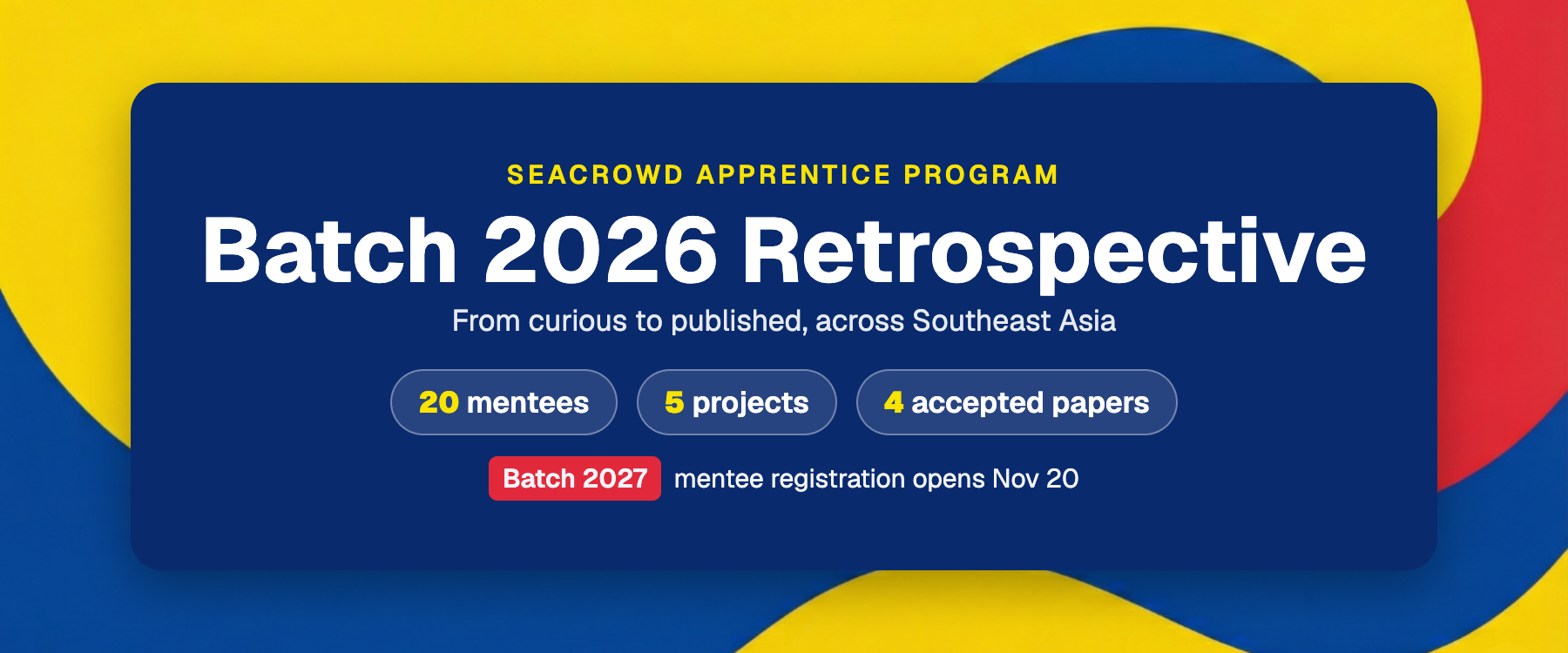
From February to June 2026, 20 mentees and 12 mentors teamed up across five research projects on multilingual agents, data curation, LLM routing, KV-cache memory, and compact vision-language models. The results blew us away: four papers accepted at EMNLP Findings 2026, ACCV 2026, and the COLM 2026 Context Beyond the Window Workshop. Mentees rated their likelihood to recommend the program at 4.79 / 5.0 and their interest in continuing AI research at 4.50 / 5.0.
Their feedback also showed us how to improve mentee experience for future iterations. Mentee registration for Batch 2027 runs from Friday, November 20 to Sunday, December 13, 2026, and you can register here.
Batch 2026 at a Glance
After Batch 2024–25, we tightened the program’s structure to help teams keep momentum through the tough middle months of research:
- A fixed 5-month window instead of an open-ended finish line
- A structured mid-term review in April so teams could get early cross-mentor feedback and course-correct
- A community-wide final showcase in July, where all five teams delivered six research presentations
What We Accomplished in Batch 2026
Across five teams, mentees didn’t work on toy problems—they built benchmarks, curated datasets, compressed models, and ran full experimental pipelines from scratch:
- Multilingual Agent Evaluation for SEA → SEATauBench, published at EMNLP Findings 2026
- Context-Aware Low-Resource Data Curation → CoRaL, presented at the Final Milestone Showcase
- Skill-Based Cost-Efficient LLM Routing → Reasoning Agentic LLM Router, presented at the Final Milestone Showcase
- Continual & Online KV-Cache Compression → Adaptive KV Memory, 2 papers accepted at the COLM 2026 Workshop on Context Beyond the Window
- Sub-50M Multilingual Vision-Text Embeddings → SEA-CLIP-Tiny, accepted at ACCV 2026
Explore the full list on our Batch 2026 Projects page, or click each project below for a closer look!
👥 Mentees: My (Chiffon) Nguyen, Aulia Adila, Saksorn Ruangtanusak, Kittiphat Leesombatwathana, Vissuta Gunawan Lim
🧭 Mentors: Samuel Cahyawijaya, Patomporn Payoungkhamdee
→ Read paper at EMNLP Findings 2026 · arXiv · Code & Data
The problem
Most AI agent benchmarks only test English. If an AI assistant can look up policies, call tools, and solve user tasks in English, can we assume it works just as reliably when the conversation, tools, and domain context are in Southeast Asian languages?
The approach
The team created SEATauBench (pronounced “si-tau-bench”, like sitaw, the Filipino word for string beans), adapting τ²-Bench across Mandarin, Vietnamese, Thai, Indonesian, and Filipino. Instead of translating everything at once, they designed progressive localization stages—first localizing only the user dialogue, then tool schemas, and finally the full local task domain.
Why this matters
While English capabilities transfer reasonably well when only the chat language changes, agent reliability drops sharply once tools and domains are localized. SEATauBench proves that English-only agent scores cannot predict real-world readiness for SEA sovereign AI—and gives the community a reusable benchmark to close that gap.
👥 Mentees: Thanh-Nhi Nguyen, Feliks Victor Parningotan Samosir, Michael Christlambert Sinanta
🧭 Mentors: Fajri Koto, Muhammad Dehan Al Kautsar
The problem
Web corpora for low-resource languages are full of noise and code-mixing. Aggressive filtering throws away scarce cultural knowledge, while keeping everything pollutes pre-training with low-quality text.
The approach
The team built CoRaL (Contextual Relevance and Linguistic Enrichment), a multi-dimensional curation pipeline that scores text on linguistic purity, topical relevance, and cross-lingual interference. Rather than a binary keep-or-drop filter, CoRaL retains clean text, repairs mid-quality samples via denoising and regeneration, discards unusable noise, and explores dictionary-guided generation for scarce SEA languages.
Why this matters
Hundreds of millions of people in Southeast Asia speak languages that lack clean web-scale data. CoRaL treats data curation as preserving cultural and linguistic value—not just chasing raw token counts.
👥 Mentees: Napol Rachatasumrit, Quyen Le Hoang Tran, Jaycent Gunawan Ongris
🧭 Mentors: Genta Indra Winata, David Anugraha
The problem
Routing every prompt to a frontier model is too expensive, while routing everything to a small model hurts accuracy. Existing routers rarely account for the fine-grained skills a specific query requires.
The approach
The team developed a skill-based LLM routing framework grounded in model capability profiles and reasoning-based sampling strategies—matching each incoming task to the most cost-effective model capable of handling it, cutting inference costs by ~35% in mid-term benchmarks without sacrificing accuracy.
Why this matters
Making capable AI practical in resource-constrained Southeast Asian settings means making inference affordable, not just chasing bigger models.
👥 Mentees: Faeyza Rishad Ardi, Izaaz Inhar, Phudish Prateepamornkul, Quang Minh Nguyen, Tri Q. Vo
🧭 Mentors: Alham Fikri Aji, Farid Adilazuarda, M. Reza Qorib
→ View project page · Gating paper · Compaction paper
The problem
Long-context reading and long Chain-of-Thought reasoning cause the Key-Value (KV) cache to balloon in memory and latency. Worse, real-world deployments keep seeing new documents over time, forcing compressed memories to learn new information without forgetting old context.
The approach
Splitting into two focused sub-teams, mentees produced two first-authored workshop papers at the Context Beyond the Window Workshop @ COLM 2026:
- Continual Compressed Memory: Added statistical TF-IDF and Mixture-of-Experts gating to Cartridge-style compressed KV caches, improving both knowledge retention and new-corpus learning on Llama-3.2-3B and Qwen3-4B.
- Online KV Compaction for Long Reasoning: Combined token merging with learnable Gumbel-Sigmoid token dropping, reaching 8× compression, cutting peak KV memory by ~83%, boosting throughput by >22%, and improving AIME 26 and HMMT-Feb 26 scores on Qwen3-1.7B.
Why this matters
Memory bottlenecks hit resource-limited labs and practitioners first. Both papers show how compact models can reason longer and retain knowledge on a tight memory budget.
👥 Mentees: Puja Ahmad Habibi, Faiz Assabil Firdaus, Ashvanth S, Ilma Aliya Fiddien
🧭 Mentors: Peerat Limkonchotiwat, Ekapol Chuangsuwanich, Pume Tuchinda
→ Read paper at ACCV 2026 · HuggingFace Model · Code
The problem
Multilingual vision-language models either underperform on Southeast Asian languages or are far too heavy to run on everyday consumer hardware and edge devices.
The approach
The team distilled SEA-CLIP-Tiny, a compact 46M-parameter vision-text embedding model supporting English and seven SEA languages (Indonesian, Javanese, Sundanese, Malay, Thai, Vietnamese, and Burmese) using regionally curated data and multilingual teacher guidance.
Why this matters
Across seven SEA languages, SEA-CLIP-Tiny outperformed MobileCLIP2 by +12.1 points on average R@10 while using 38.4% fewer parameters and running faster on CPU—showing that region-aware distillation beats generic compression.
Did the Program Help Mentees Grow?
Papers are only half the story. Our real goal is helping early-career talent build confidence, skills, and momentum in AI research. At the end of Batch 2026, we surveyed our mentees on a 5-point scale:
Every single metric landed between 4.37 and 4.79 out of 5.0. Seeing 4.50 / 5.0 on wanting to pursue AI research afterward—and 4.79 / 5.0 on recommending the program to peers—is the clearest sign that the program is fulfilling its mission.
Voices from the 2026 Cohort
One of my favorite parts of SEACrowd is that our mentees don’t fit a single mold. Batch 2026 brought together undergraduate students taking their first shot at research, master’s students, industry ML engineers and data scientists, AI researchers, and university educators. Here is what they shared:
"Very nice program! I totally love that we can collaborate on AI research with new people and new cultures. This is a very short and intensive program — we pushed hard for 4 months and got a publication!"
"As a person who hasn't done any prior research, SEACrowd Apprentice Program is a great first step for me. This program gives me experience of conducting research as a team with people from different countries... Community-wise, SEACrowd is filled with great yet supportive people."
"I think this is an amazing and focused initiative targeted quite clearly towards early-career researchers in this region. The application and selection process is straightforward and clear... And it helps both in our connections with other early-career and experienced researchers, and our research experience itself."
"I really recommend researchers (especially early-career ones) to join this program. It's a wholesome way to learn about research (like AI research 101), because as a mentee, you get the full end-to-end real experience on how to identify your research questions, answer the problem scientifically, and present your work to the audience."
"The program has been an incredibly rewarding experience right from going through the ideation process to getting to conduct experiments... There are not a lot of organisations focusing on cultivating a space to improve AI ecosystems particularly for multilinguality, hence I would urge people... to join the SEACrowd program."
"SEACrowd Apprentice Program was my first completed substantial AI research experience. I came in for a project I was interested in, and for the potential to publish as co-first author. I accomplished these goals, but what I valued more were how to do research in a distributed setting, support from mentors, and great teammates I enjoyed working with."
"The SEACrowd Apprentice Program 2026 gave me the chance to work on real, meaningful research — in my case, building synthetic data for low-resource languages under Project CoRaL. The mentors guided me throughout the research process, and discussions with fellow mentees made the experience even more valuable."
"What stood out most was the chance to learn and do research alongside people whose names I had only known from papers, and seeing fellow researchers from Southeast Asia, especially Indonesia, share their work was truly inspiring. This experience has motivated me to keep pushing forward in learning, teaching, and researching NLP for the Indonesian context."
What We Learned (and What We’re Changing)
Our post-program survey and discussions surfaced three practical pain points. None of them were fatal, but each one made the experience harder than it needed to be, so we are fixing all three for Batch 2027.
The first was scheduling. Mentors and mentees were spread across Southeast Asia, Europe, the Middle East, and North America, and finding a weekly meeting slot that worked for everyone was tough. Applicants also couldn’t see a team’s timezone spread before they joined. In 2027, every project description will state the timezone range of its mentor group, so you can tell upfront whether a team’s schedule fits your week.
The second was compute. Running LLM and multimodal experiments costs money, and because SEACrowd is a volunteer-run non-profit without a central compute grant, some mentors and mentees ended up covering those costs themselves. We didn’t say this clearly enough during applications, and that was our mistake. From now on we will be explicit during applications that SEACrowd does not directly provide compute funding, while noting that individual mentors may help cover compute if they are willing and able to.
The third was the mentor hierarchy. We originally split mentors into primary and secondary roles, but in practice this blurred who owned decisions and how mentorship duties were divided. For 2027 we are removing the primary/secondary split altogether. All mentors on a team will serve on equal footing, which keeps the multi-mentor support without the unnecessary hierarchy.
So Was It Worth It?
Yes—more than ever.
In five months, 20 mentees collaborated across borders, tackled genuinely hard AI problems for Southeast Asia, delivered six final presentations, and landed four papers at respected international venues. Even better, students, engineers, and lecturers walked away knowing that world-class AI research isn’t out of reach—it’s something they can lead.
A huge thank-you to every mentee who pushed through failed experiments and tight deadlines, to all 12 mentors who volunteered their evenings and weekends, and to our organizers Aye Hninn Khine and Holy Lovenia for keeping the entire cohort running smoothly.
How to Join Batch 2027
Ready to make the jump from “curious about AI research” to “I’ve actually done it”? Consider applying to the SEACrowd 2027 Apprentice Program if you:
- Are affiliated with, born/raised in, or doing research connected to Southeast Asia
- Have foundational Python and AI/ML/NLP familiarity (prior publications are not required!)
- Can commit at least 10 hours/week (15–20 hours recommended) from February to June 2027
- Want hands-on mentorship toward grad school, PhD applications, or AI research roles
While we cannot guarantee a paper for every team, we offer real research problems, dedicated mentors, a supportive SEA-wide peer network, and a Certificate of Achievement (plus recommendation letters for strong contributors).
- 🗓️ Registration Period: Friday, November 20, 2026 – Sunday, December 13, 2026
- 📝 Registration Form: Submit your Batch 2027 Mentee Application
- 🌐 Program Info & FAQs: SEACrowd Apprentice Program page
If you have questions, reach us at seacrowd.research@gmail.com or join #apprentice-program on SEACrowd Discord—and if you’d like to help empower the next generation of SEA researchers, you can support SEACrowd here.